Read Transcript
Child: Welcome to my mommy’s podcast!
Katie: This podcast is brought to you by Hiya for children and especially I love to talk about their new greens line for children. Now, I have tasted these vitamins and they’re delicious, and my kids are the ones who really love them though. And I love that they’re getting the nutrients they need without the sugar because most children’s vitamins are basically candy in disguise with up to two teaspoons of sugar and dyes and unhealthy chemicals or gummy additives that we don’t want our kids to have.
So Hiya created a superpowered children’s vitamin that’s chewable, without the sugar or the nasty additives and it tastes great. My little ones love it. They especially are designed to fill the most common gaps in modern children’s diets to provide full body nourishment with a taste kids love. And it was formulated with the help of pediatricians and nutritional experts and pressed with a blend of 12 organic fruits and vegetables, then supercharged with 15 essential vitamins and minerals, including vitamin D, B12, C, zinc and folate among others.
It’s also non-GMO, vegan, dairy free, allergy free, gelatin free, nut free, and everything else you can imagine. I love that they test every single batch with third party testing for heavy heavy metals and microbials in a qualified GMP compliant lab using scientifically validated testing methods so you can be completely at ease knowing it’s safe and nutritious and it’s designed for kids and sent straight to your door so you don’t have to worry about ordering.
My kids really like these and I love that refills show up on schedule with no stress. Also, again, honorable mention to their new greens because if you are tired of battling your kids to eat more greens, their Daily Greens Plus Superfoods is a chocolate flavored greens powder designed specifically for kids and packed with 55+ whole food ingredients to support kids’ brains, their development, their digestion, and kids actually like it. We’ve worked out a special deal with Hiya for the bestselling children’s vitamin. Receive 50% off your first order. To claim this deal you must go to hiyahealth.com/fitbottomedzone. This deal is not available on their regular website. To get your kids the full body nourishment they need.
And this episode is brought to you by Apollo Neuro. This is a tool that has really helped me feel more relaxed and de-stress. It’s an Apollo wearable that can be worn anywhere on your body, and it tracks sleep like other wearables. But unlike other wearables, it actually improves my sleep automatically.
Apollo was designed by a team of scientists and doctors to emit silent, soothing soundwave vibrations that actually feel really good and work in the moment, so it feels like a hug. These waves are proven in scientific studies to help us shift into recovery mode, so we experience less stress, better mood, more energy, and better sleep.
The sleep setting is probably my favorite. Apollo is also the first wearable proven to significantly increase HRV, which is heart rate variability, which is a leading biomarker for health and longevity. It works at the most foundational level to improve nervous system balance through our sense of touch.
Just like getting a warm hug from a friend or snuggling a pet. Apollo connects to an app on your phone so you can choose the settings for mood and energy and the level you need. I’ve used mine for years and I definitely noticed the benefits. I especially love it when traveling as well. It’s especially great for moms because it has no side effects and it’s safe if you’re pregnant or nursing.
You can learn more about Apollo and get your own by going to apolloneuro.com/fitbottomedzone. So find out more and get your own by going to apolloneuro.com/fitbottomedzone and use the code fitbottomedzone all caps and one word, for a discount.
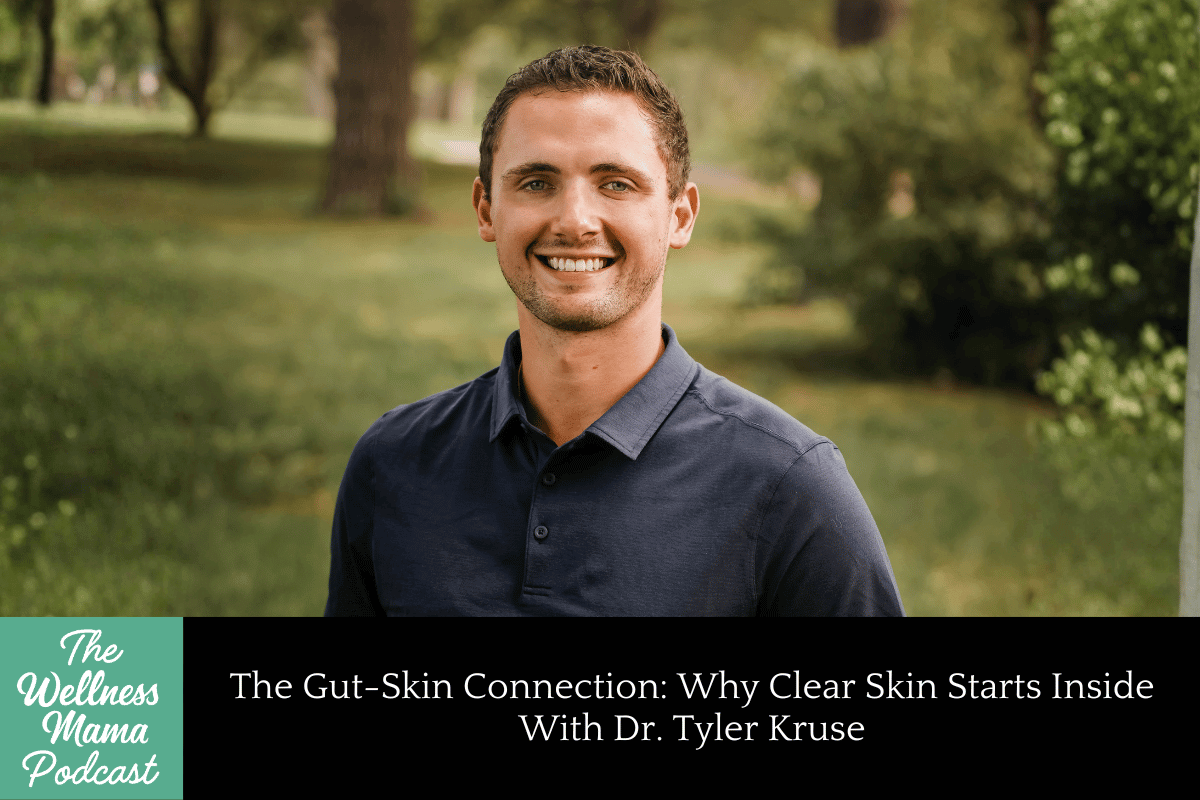
Katie: Hello and welcome to the Fit Bottomed Zone podcast. I’m Katie from fitbottomedzone.com, and I’m here today with Dr. Tyler Kruse to talk about the gut skin connection and why clear skin starts from the insiden. Ad we get to go in some fascinating directions in this conversation. He makes a very strong case for how almost every skin issue is a reflection of something going on internally and deserves an internal look at the gut, not just treatment on the skin itself.
We talk about autoimmunity, we talk about natural light, we talk about melanin, we talk about germ and terrain theory and what the difference is there. And so much more. Definitely a fascinating conversation. If you’re not familiar with him, he is a chiropractor and holistic health advocate who helps people reconnect with natural sustainable ways to heal.
And he has years of experience working with people across the board and with different backgrounds focusing on gut health, nervous system, balance, hormones, immune system, and whole body wellness. And I’ll link to his resources in the show notes as well. Let’s jump in and learn.
Dr. Tyler, welcome. Thank you so much for being here.
Tyler: Yeah, thanks for the invite. I’m super excited to get to chat with you. You’ve had a lot of great people on your podcast. I’m excited to be a part of that, and we have some great topics to share with your audience today.
Katie: Right. I am excited to learn from you today. And I feel like our first topic is gonna be especially relevant to a subset of the people listening. And actually, like personally, it was relevant to me historically in that, one of my kids was born via a c-section due to placenta previa, and he had skin issues when he was young, which led me into a deep dive on gut health. We eventually reversed his eczema and his gut issues, and now he has no food intolerances and is doing great.
But that was a long process. And I think I learned a lot of things the hard way in that versus having a guide who actually knew what they were doing. And from researching for this episode, it sounds like you also actually had personal experience with this that somewhat led into the work that you’re doing.
And I wanna make sure we go deep on the solutions today. But as background, can you walk us through how you got into this and maybe some of the kind of foundational things that you learned along the way?
Tyler: Yeah, absolutely. So, when I kind of got more into the natural health or kind of healing my body from more of a natural standpoint was actually more based on like my mom and my sister’s health. So then I started to get into it as well, and I never really thought much of it. So a lot of people think that their eczema or their skin conditions or you know, all of these, you know, even maybe an autoimmune condition or whatnot is normal, right?
They’re told, hey, you’ll have to live with this. Hey, you’re gonna have to do this. And I was no different, right? So my big thing was my fingertips. The skin was like peeling back, so it would always look pink. It would always be very tender to the touch. Because my skin would peel and most, you know, I tried every steroid cream you can imagine.
I tried every antibiotic. I played hockey growing up and almost every single doctor’s approach to me was, you know, hey, you have bacterial, you know, bacteria in your gloves that aren’t, you know, airing out properly. Different things like that. And so it got to the point where we would professionally clean my gloves after every practice, every game.
And that’s a big financial burden to have somebody do that after every single time I wore them and it didn’t get better. And so, I actually went to my chiropractor then, as a lot of people probably saw in here, I am a chiropractor, we did a lot of the adjusting side of things. And I mentioned it to her and she’s like, hey, let me do a little bit of research.
And she started to just give me some supplements and I hadn’t done any testing at that point. I would take the supplements, it would literally get better. I’d be like, I don’t want to take these forever. I’d stop. It would get worse. And so that was a really good indication. You know, at that point, looking back that something else was going on in my body, right?
And that was no different than, you know, like a medicine approach, right? Medicine’s there to do its job. And then from there we need to figure out why, you know, why you were dependent on it. And so I was dependent on that supplement and I couldn’t figure out why. And it wasn’t until later on, after hockey and even getting to college, I had some mold toxicity at college looking back, different things like that.
But it wasn’t until I actually looked at my digestive tract that you had kind of alluded to with your child, and my food allergies at that point. So it turned out I had 22 different IgG food allergies. I did not have any IgEs, but and then when I looked at my digestive tract, I had an imbalanced gut microbiome, I had infections going on.
I had a very high beta glucuronidase. I wasn’t eliminating things well. So then it started to add up, like, okay, if my pathways are restricted or I’m not eliminating properly, well then that makes a lot of sense on why stuff’s showing up under my skin because it has to get outta my body, right? My body doesn’t want that in there.
And so that was kind of my eye-opening experience. And it wasn’t until I actually did that, that now I don’t have to… Yes, I still take supplements based on my testing, just the world we live in, that kind of stuff. Support my body with what’s necessary, but I’m not dependent on it to keep my fingertips from peeling.
And I mean it was at the point too where it was so painful I didn’t wanna shake people’s hands. I didn’t want to, you know, even show people my hands and let alone I had already decided I wanted to be a chiropractor at that point, which obviously we adjust people, we do a lot more, at the Wellness Way Coralville here.
But, with that, you know, I was like, what am I gonna do? You know, I can’t be, you know, having people see my fingertips like this. So that was kind of the long story short, once I started to get my elimination pathways better, I got my inflammation down. My immune system started to heal. Things got a lot better from that skin standpoint.
Katie: Yeah, this is so fascinating to me. And I would guess it sounds like it’s very much a multifaceted thing of which the gut is a big piece and not necessarily the one that’s first looked at when someone maybe just goes to a dermatologist, for instance. They’re probably not first asked like, what are you, what do you eat? And how their gut health is. Or given a stool test. I love that you also touched on the autoimmunity side because that is very relevant to me personally in that, years ago I was told I had Hashimoto’s, that I would have it for the rest of my life. That it is, there’s nothing that I could do about it.
That food of course doesn’t help. There’s nothing that I could do at home that would help, and I would just need to take medication for the rest of my life, which, longtime listeners know is not the case. I now take no medication. I have no antibodies. Things are not just in remission, I have no signs of autoimmunity.
So I know firsthand it can be possible. And I also know that is not commonly talked about. That’s definitely not told to people by most practitioners. So I love when I find someone like you who’s willing to like really do that deep dive, go into the root cause and help someone actually resolve something versus kind of mask it. And you mentioned that when things come out of the skin, that that’s kind of, it’s indicative of what’s going on on the inside and that that’s sort of, if it has to come out of the skin, it’s because it can’t be handled effectively internally. Can you go deeper on that and maybe talk about like, how does gut health show up on the skin?
What’s happening kind of underneath the surface when we see something on the surface?
Tyler: Yeah, so when we see stuff on the surface, a lot of times, you know, the word leaky gut gets thrown around out there, hyper intestinal permeability, however you want to word it. But when you have that going on, your gut lining is going to be compromised. And what that’s gonna do, is, is you have a majority of your immune system in your gut.
I don’t want to give an exact percentage. I usually say an estimate, 75 to 85% of your immune system stems in your gut microbiome. And so if you’re starting to have imbalances, dysbiosis, different changes in your gut microbiome that aren’t properly supported or addressed, and that’s why it’s so important to stay on top of things, right?
So, you know, like, think of exercise for example. Everybody you know, that is exercise likes to do it daily or, you know, multiple times a week. So, you know, that’s where like testing comes into play is staying on top of your gut. My gut can look a lot different, you know, end of July here, then it will in December based on, you know, did I make good decisions around the holidays?
Did I do different, you know, support for my digestive tract? And the other thing that I really like with testing from a gut microbiome and a skin standpoint, is a lot of people, that have bloating, indigestion, or skin conditions and a lot of skin conditions from a gut issue are gonna show up as, you know, flareups with certain foods, rashes, eczemas, you know, different peeling, like in my situation.
And I can honestly… when I’m like walking through public, I’m at the grocery store, I’m getting my groceries, I can pick out if, like, yeah, that gut, that gut needs help. You know, I can tell by looking at somebody’s skin, you know, what the inside kind of looks like. Because it’s such a major organ.
It’s kind of like our body’s alarm system, right? I mean, you have a fire alarm at your house or where, at your residence. If there’s a fire, well, same thing. If there’s a fire inside, that’s our alarm system is our skin. And so, you know, big things that you can tell, like I mentioned, rashes, eczema.
The other thing is just like the quality of them. Can they hold a good tan? You know, then you’re getting into like the melatonin or, sorry, the melanin and the different skin tones and whatnot. But also another kind of test that, if people have severe like histamine or mast cell activation, which a lot of people in today’s world do just based off of the processed food we live in, the environments that we’re in. But like, I’ll tell some people, you know, just take your hand and just rub it on your skin and if that turns super red, super fast, you have some subcutaneous, you know, high amounts of, you know, histamine, inflammation. You know, we don’t know for sure till we dive in a little bit.
But that’s a pretty good indication. So, by looking at like the redness, the quality of their skin. You know, is it, does it look good? Like good moisture? You know, like those kinds of things are gonna be really important. The other things, you know, how are they aging? You know, that’s stuff that we can look at from the skin, but a lot of times it’s gonna show up with eczema.
Acnes, you can look at the patterns. Is it more on the jaw? Is it more on the back? Is it all over the place? I have a few patients that come to mind. One of them is, she actually sat in front of me and her legs were like bleeding because her rashes and her eczema was so bad. And she’s like, I, basically, I tried everything.
And just a month into working on dietary and digestive tract, she’s like, it’s 98% better. She’s like, it hasn’t bled, it hasn’t done this. And so just by looking at okay, knowing that like, hey, I’m not gonna give you anything to do topically here. I guess here’s something if it really, really hurts, but if we keep doing that approach, you’re gonna be in the same boat in a year.
And so that was one way that gut showed up on the skin there. One of my earliest patients in practice, kind of a, not really crazy situation, but how it showed up was it was just a little bit of a red rash. Didn’t hurt her, nothing like that. She literally came in and said, hey, I’ve had this for 10 to 15 years.
It’s literally cosmetic. I don’t feel the pain, I don’t do anything. But like, I go to the swimming pool with my kids. I like to wear a swimsuit and people notice it. And it’s kind of embarrassing, just personally, right? It would help my, it would help my confidence to have this gone. And I was like, sweet.
Let’s look at your gut. Let’s look at your diet. Turns out. She had an IgG food allergy, which I know that some people have controversy with those. The labs that you use for testing is very imperative. I will put that out there. Make sure you get a very good quality that’s researched.
But, long story short, with that story is she had an IgG to broccoli. Well, broccoli is a very healthy food, cruciferous vegetable for, you know, 95% plus of the world. But in her situation, her immune system was struggling with that at that given time. And so that was one thing we had to cut out. Now she had some stuff in her stool test, but you know, just kind of a you know, it probably never would’ve been a, nothing we could do topically to make that rash go away until we looked at the inside.
And so, those are kinds of ways that they’re gonna show up. Now non-skin symptoms, bloating, constipated, which constipation and skin, I really want to hit on that for a second because a lot of people don’t realize, you know, a lot of people are constipated and they don’t realize it. So one bowel movement minimum, one to two a day is what I like to see of good consistency. And so I’ll get patients like, oh, three times a week’s not good? I’m like, no, that’s not, that’s fermentation. That’s not elimination. Eliminating, you know, pathogens, toxins, recycling hormones, I mean, stool’s a major detoxification pathway. So very common to see constipation and skin concerns, come together.
And so that’s one way that you can get a pretty good idea of, you know, your health as well is skin. And then bowel movements.
Katie: I am definitely excited to go deeper on that and especially because I feel like this really challenges the idea that the skin is sort of like an isolated organ and helps connect it to the rest of the body, which also then makes it seem more logical that you’re not just gonna treat the skin topically, which is definitely how I used to think of it, especially when I was a teenager who had acne, for instance, it was like, what can I put on my skin that’s gonna fix this, vs, I didn’t think to look internally at that age, of course.
And I know many teenagers now are on pretty harsh things, even including like Accutane, which can have some really serious side effects, but which is an internal thing that they take. But I’m curious, like, what are some of the key signs that something might be more than just skin deep or is it pretty much indicative if there’s skin issues, there’s likely something always kind of going on under the surface also?
Tyler: Yeah. I would say if you have some degree of a skin concern, there’s something going on deeper down. The skin is that kind of, that alarm system so you can know something’s going deeper down. Now, like you had kind of mentioned when you were younger, there’s a time and place where the acne may be more hormonally driven.
Yep, absolutely. And that’s why looking at the body as a whole is very imperative. But, by working on your gut, in turn that should, you know, intuitively help your skin if you get your stress response down. So anytime you see an issue with the skin, you know, rashes, eczemas, peeling of the skins, you know, redness, you know, it’s kind of like if, you know, you get a bug bite or a cut, it becomes red.
You know, that’s a really good indication because, you had kind of mentioned the skin is a phenomenal thing to look at because it tells so much internally and it’s really honestly, in my opinion, our biggest organ because we have so much skin on our body and it’s exposed to so much. And it’s really actually our first barrier too.
Because on a daily basis with the world we live in with, you know, with EMF exposure, with, you know, the VOCs that we’re exposed to, the diesel fuels, the all this stuff that’s just very chemically sound. You know, glyphosate, roundup, our skin goes through a lot. And so it’s a really good barrier. And, and honestly, that’s why, you know, sometimes things that bypass that skin barrier can become, you know, immune system stressors as well.
Because you have that barrier. Your nasal cavity has a barrier, your oral cavity has barriers. So you have a lot of barriers before we even get to your digestive tract. And so, you know, that just shows that when we have the amount of, you know, toxic load that we have, you know, eventually that is going to start to affect the gut microbiome.
And then when the gut microbiome’s affected, the immune system’s affected. And so that’s one thing too, when it comes to like viruses and pathogens and mold toxicities, you know? Yes. If you’re living in a house and I touched the wall right here and it falls down, yeah. Chances are that mold’s pretty hard on the immune system.
Right. I mean, we don’t want to be exposed to high amounts of toxic mold over long periods of time. But in the long run too, I kind of like to look at it from what I call a terrain in a germ theory, right? So a lot of people from the germ theory would say that mold is making me severely sick. And I don’t disagree with that necessarily because that is a fungal, that is a toxin, but also what’s the state of your terrain?
Because some people are in a moldy environment and not as affected as others. Now there’s the, you know, you, we’re, we could get down a rabbit hole of, you know, okay, what’s the methylation, the elimination pathways, all of that plays a factor too, you know, but the gut plays a major role. Because if you already have yeast infections, then you’re exposed to that.
Your immune system’s suppressed then yeah, that, I am worried about that mold exposure for you. But if you have a healthy terrain, you’ve focused on your immune response, you have the nutrients you need, you probably can handle that exposure a little bit better. Now that’s not to discount the fact, like I said, if you’re exposed to bad mycotoxin environment on a day in, day out basis, you’re sleeping in it, you’re cooking in it, you’re living in it.
You know, yes, that’s something we wanna have a conversation about, but I also don’t want people to get so, in tune with a germ theory approach of like, you know, that virus, you know, that flu virus is the reason I feel the way that I do. It’s like. I mean, yeah, the virus made you sick, but what does your terrain look like?
Why did it take over so bad? Do your barriers, are they in bad condition? Is your gut lining in such a bad condition that it’s just going through to your bloodstream? That your immune system is having to get beat up. I mean, you had mentioned with your autoimmune journey, which is phenomenal. I love hearing stories like that because that is a prime example of, you know, some people may never get the antibodies to go away.
Some will like you. But if you do the right changes, your symptomatic can change because auto like autoimmune for example, looking at the gut and then like something like a mold or environmental exposure is a major component, which, you know, the diet is too, especially in something like a Hashimoto’s.
But, when I think of autoimmunity. Some things that blow my mind with it is, I love to use the example of celiacs because if someone tells you they have a celiac disease, everybody knows you can’t eat gluten. Okay. So that’s the one autoimmune condition that we’ve pinpointed a trigger for.
So that right there tells you by definition that an autoimmune condition has a trigger. And so with that, we should have kind of a light bulb moment at that point and understand that, okay, the immune system’s affected and it’s driving an autoimmunity, but that immune system’s not necessarily making a mistake there.
It’s responding to the stressors that placed on it. So back to the Celiacs example. We know that gluten’s a stressor. So if you eat gluten and you have celiacs, is it your immune system’s fault or is it your fault for eating gluten that you know triggers that celiacs? And so that’s what I dive into deep with an autoimmune, side of things or an immune system side of things.
Regardless if you have an autoimmune response or not, we want to find what’s triggering your immune system that we can make changes on, because overall speaking. Our bodies can handle a lot, right? We were meant to handle a lot of stress, but eventually between physical, chemical and emotional stress, which we call ’em the three T’s here, thoughts, traumas, toxins, and that’s why chiropractic care, that’s why exercise, physical stuff, is phenomenal. But then we also need to look at the chemical and the emotional side of things. And that’s where if we can encompass all of those, that’s where we can start to see improvement, which it sounds like you were able to do. Which, like I said, I love hearing those stories because not only does that drive hope into somebody’s, you know, health journey, which I think is a very, very big misconception.
So I many times have conversations with patients and it’s as simple as, look, I need you to believe that you can heal. Because there’s an emotional component to that. And if you don’t actually believe that you can heal from this, you know, then we can do all we can. We may get a little bit of improvement, but we have to get you emotionally connected to this, because there’s a major emotional stressor.
And kind of back to, I was thinking of your analogy earlier. I usually use the, with like the root, you know, getting to the root and what was really going on. I love this analogy, and I use it with quite a few patients. So if you have issues, I think of it as a gas tank.
So if you have a hole in the gas tank, it’s gonna be drained. A lot of today’s society, instead of figuring out why we have the hole and what can we do to fix that, they just grab the gas and keep filling the container and hope that it never runs out. But if we fix that, you know why that is, then theoretically we could fill it up, not have to constantly be filling it up.
And some of that has to do with the microwave society we live in. We have way too much fast food available to people. You know, they’re ordering it. They’re going through the drive through, they’re getting a brown paper bag, they rip it open and they eat it. That is one of the worst things we can do for our gut health, for our digestive tract because one of the major ways we start digestion is seeing it, smelling it, and producing those enzymes in our mouth down to our stomach to produce our stomach acid.
So a lot of these people are going in not only eating the enriched food, that’s super processed, that, but then they don’t have the proper stomach acid. They don’t have the, you know, steps A, B, and C of digestion. So they’re starting with D and then, you know, then our digestive tract not, you know, side effect of the terrible food in the first place, but then we’re not ready to digest it.
And then it just becomes more stress puts you in a sympathetic fight or flight state when really rest and digest parasympathetics more of a digestive state. And so that’s just kind of some of the things that you know, that I see from that standpoint.
Katie: Oh, you touched on so many good things, and I love that you brought up germ theory versus terrain theory. I feel like that deserves to be hopefully a whole podcast on its own at some point. Maybe we can circle back on that. But for people who are not familiar with that, I just leave the question to consider of that, of all the people exposed to something like a given quote unquote germ or virus, not every single person will get sick. And why is that? And like, looking deeper into that question, because that was a fascinating rabbit hole that I got to go down recently and it’s really, really interesting. But like I said I would end up kind of hijacking the whole conversation.
I also love that you brought up the mindset and the emotional piece because I think this part is overlooked a lot, especially in the clinical world, and at least in my experience was vital in that kind of my healing followed my mental and emotional relation to it as well in that when I was saying I’m sick, my body’s attacking itself, that was what was happening. And that was my experience that I kept reinforcing subtly even in my actions. And then when I started saying even just I am healing and every day I get better, I started noticing changes. And then as my mindset shifted to I am healed. This is no longer a thing. Then my labs eventually reflected that as well.
And of course I was doing lifestyle changes and dietary changes as well. I just feel like it’s amazing to hear a practitioner talk about the mindset side because I do think that is incredibly powerful and often not really given enough weight when it comes to just how profound it can be. On that note too, I would also love to dig into, you touched on some of them, and I love your take on fast food, not just being the food itself, but the way that it’s eaten and the removal from the creation of the food and that being problematic. What are some of the biggest triggers that you see in the modern lifestyle and diet, as like potential triggers for skin issues?
Tyler: Yeah. So some of the major things I usually tell people if you don’t have a food allergy test, there’s five categories of foods that I push people to avoid. And I’ve actually tweaked them a little bit more just based off of some of my research and stuff I’ve looked into and what I see on a daily basis with, you know, clinical observations.
But the number one thing is the conventional dairy. If you don’t have a dairy allergy, I don’t think something like grass fed, grass finished organic dairy is a bad option. I do push people more so, instead of any of the liquid cheeses, do more of the hard cheeses, the fermentation process of it has a little bit more support for our digestive tract.
But then gluten, so wheat, the big thing with the wheat is the enrichment, the way that we process it. A lot of people in America notice that too. If they go over to like Europe, they don’t feel as bad when they eat that stuff. And some of that has to do with how we process it and enrich it.
And so kind of with, wheat, I’ve added yeast. Yeast is a very opportunistic effect to not only our immune system but our gut, which kind of goes hand in hand like we talked about beforehand. But, when you eat too much yeast, you suppress your immune system. And actually what I see on a lot of food allergy tests is a brewer’s or a baker’s allergy.
And so if you have not only an allergy, or you have maybe a yeast infection in your gut, or maybe, but you know, back to mold what we talked about. Maybe you have mold fungal in your body and you start fueling that with that yeast and that brings the immune system down even more. Then we can’t respond to things and then, you know, those are the people that, like you had just mentioned with the germ and terrain theory, are in a bad situation, you know?
You know, we’ve had a lot of, you know, viruses be a big issue lately in the area. And one thing that, you know, I talk to people about is like, what’s the state of your immune system? If you don’t know what your immune system’s like you don’t know what your health like, you’re not doing things to promote your health, then you may want to be scared of that.
You may be more in the germ theory, but if you’re more in the terrain theory, you’re doing what your body needs, you know, our body’s innate immune system and our body’s adaptive immune system that we were born with know what to do with, you know, certain viruses and pathogens and that kind of stuff. So that would be number two would be gluten slash weast… yeast, sorry.
Refined sugars. So yes, glucose is essential for life. Everything breaks down to a sugar, though a lot of people don’t realize that. It just takes longer, right? If you eat a piece of grass fed, grass finished steak, that’s gonna take longer to break down to a sugar than a potato. But it all ends up as a simple starch, carbohydrate eventually.
The other things is soy. Soy is a very modified food in America. And the other thing kind of, on the thyroid side of things, you had mentioned, your journey with Hashimoto’s. But with the thyroid side of things, soy is going to slow down that thyroid. So we don’t wanna be slowing the thyroid down too much.
Now, there is a situation where you may have a hyperthyroid, you know, that kind of stuff, which is very much where you need to be working with somebody. You need to understand the physiology and the biochemistry of it. But I do push people to avoid soy, especially females as well. Because it has some degree of, you know, like a phytoestrogen, approach to it.
So it can affect your estrogens a little bit as well. So women more so, but I push men too. And then honestly, the other thing that I’ve started to add to that is, which, you know, being in the Midwest here, people probably think I’m crazy, but, I’ve added corn to that list, because corn is a very modified food as well.
It’s a very starch based food. There’s a lot of additives. The way that the farming is. There’s a lot of glyphosate stuff around, added to it. And the other thing too with, you know, corn and stuff is it’s very hard on the digestive tract, right? There’s a reason why when you eat corn, you see it in your stool.
And some people laugh about that, and I’m like, I think that just shows you you can’t digest that at all. So the whole point of eating, which this is kind of getting back to, you know, history and you know, our ancestors and whatnot and history can tell you a lot of things, not only in the health world, but in everything.
Right? But one thing you noticed is our ancestors didn’t eat for pleasure. Our ancestors ate for nutrients. They ate the entire animal. They ate it down to the bone. They ate every organ. They ate everything that they needed because food was not an emotional thing for them. Food was a necessity for them.
Now, with the, what we have at hand, how you can go to McDonald’s and get a meal for $6 and you know, and be told that, oh, it’s a Happy Meal. We’ve added a piece of fruit to it so it’s healthy. No, not necessarily, you know, not even close to the approach that we need to be with that, but what I’m getting at with that is food has become very emotional.
And so I want people, we talked about the emotional side of things, of believing you can heal, which is very key. But also we need to understand the emotional decision when we’re eating food as well. Because if you think of birthday parties, get togethers, family gatherings, hanging out on the weekend, what is it always around?
90% of the time it’s around food. Hey, let’s meet up at this restaurant. Hey, let’s do this. Let’s make this food. Now, yes, you could be making, you know, organic healthy options and having a good get together with your friends, but my point with that is we’ve become very emotional food. If you have a stressful day, what do you want?
You don’t want a nice organic steak with an organic salad. You want chocolate, and there’s a reason you want that because that’s putting you in the fight or flight state that’s changing your cortisol, and changing your circadian rhythm as well. I really push people to avoid those, avoided foods.
And then another thing that I’m starting to get into more, which I know you recently had some people on the podcast talk about mold toxicity, which is becoming a very big thing. But one thing that I’ve started to find in certain foods, and not even if you have a proven mold issue, but I’m finding that the way that citric acid is derived in synthetic form, is affecting people very negatively.
And why that is, is citric acid, if you look into the derivate, how it’s derived. It’s based on corn to some degree, but it’s based on aspergillus niger, which is a mold. And so they’re basically synthetically deriving citric acid from a mold and putting it into drinks, certain foods, certain even electrolyte powders.
And the level matters. Don’t get me wrong with that, the level matters, but when you’re putting that into your body, if you, especially if you have a, you know, if you’re more sensitive to mold, or viruses or you know, your immune system’s not in a great situation, you know, that can really affect you as well.
So I’ve kind of added that list. And I use this with some patients too. People have heard of the whole food diet. I mean, there’s a reason that, you know, certain foods that the earth can produce are better. A few other kind of quick tips I like to give people on the nutritional side of things is the longer the list of the ingredients, the better chance you should probably put it back on the shelf. If you’re having to open a box, there’s a chance you should put it back on the shelf. And then kind of more restrictive, but gets the point across, two points to this, is if it has a label, chances are it may not be the best option for you. So, aka your fruits, your vegetables, your meat counter don’t have labels on them usually.
And then the third thing, which this is just my opinion, it very well could not have anything to do with it. But if you notice a grocery store when you walk in, what’s on the outside? Vegetables, fruits, meat, what’s right in the center of the store, all the processed boxes of mac and cheese, candies, all of that kind of stuff.
That’s just, in my opinion, a marketing strategy because when you go to a store, you’re through, you’re around the center of the store a lot more than you are on the outside. And so they know that A, it’s cheaper to process that. Two, a lot of those foods have MSGs that stimulate our glutamate. And then while you eat it, you’re like, yes, I feel amazing. That is exactly what I need. My stress is so much better. And then 10 minutes later you’re like. Oh man, I got diarrhea, my gut hurts. All of that kind of stuff. It’s because they’ve added that to the food. It’s affecting our neurotransmitters. But that’s just, honestly, it’s just my opinion.
There’s no research that shows that’s why grocery stores do it that way. But I think it is because every grocery store I go into, the dead center of it is never good, healthy options for people. And a lot of times the health market’s way off on the side too, which that’s another, we could go down a whole podcast to that, like you had mentioned with the germ theory and terrain theory is, I, why does a store need a health market?
Shouldn’t all food that we’re providing people be, you know, to some degree beneficial for our health, but instead we have a health market. So, or organic section, whatever you wanna call it. But yeah, that’s just a whole nother rabbit hole that I always question when I’m in stores.
Katie: Yeah. And a section that’s often, like you said, very hard to find or obscure or like divided up into little sections that are like really hard, difficult to find. I know I’ve, there’ve been grocery stores I’ve been to for years and then finally found sections I didn’t even know were there that had more organic options. But you’re right, it could be a whole nother podcast. And I know we’re getting to the end of our time for this episode. You guys stay tuned because we’re gonna do another episode that goes even deeper on this with the gut stress connection. But before we put a pin in this one, I wanna just briefly touch on one more thing that you said, which was about melanin and the ability of the skin to handle sun exposure in a healthy way and the connection to inflammation here.
And the reason I wanna bring this up is, A, that anytime I get to talk about the benefits of natural light in the sun, I love to do that. And, B, I have Irish German heritage. I used to burn in five minutes growing up. And with all the dietary and lifestyle changes and in the reversal of my autoimmunity, I now do not sunburn even living at the beach and can handle sun exposure in normal healthy amounts no problem. But more importantly, I used to be vitamin D deficient all the time, taking supplements did absolutely nothing. Now with getting sun exposure, my most recent test, it was 86, naturally with no supplements.
So I just love to bring this up because I feel like it’s another like massively impactful and often overlooked area of skin health.
Tyler: Yeah, absolutely. Which 86 is a great number. I usually say 70 to 80 and then if you’re auto, if you autoimmune or history of it above 80 is what I like to see. So that’s phenomenal. But that’s just a greater testament to what, I actually talked to a lot of people about if you burn easily, you know, you’re a prime example of this, It doesn’t really matter what your ancestors or your heritage is, If you burn easily, that’s a sign that you have digestive distress. And the, or liver health. And the reason I say that is a lot of vitamin D is converted in the liver. But like you had mentioned, you know, sometimes supplements don’t raise that up.
And a lot of that has to do with vitamin D is a fat soluble vitamin. And so you have vitamin A, D, E, and K are your fat soluble vitamins. And so you have to be able to break down a fat to get the benefit of vitamin D. And so, like you had kind of mentioned, by far, the best source is natural, which on our next podcast, I’m gonna talk, you know, probably bring up circadian rhythm a lot just with stress and whatnot.
But sunlight helps set that circadian rhythm. So a really good thing you can do is watch the sunrise and watch it come down. And that helps with setting the circadian rhythm. But, being able to digest and absorb a fat soluble vitamin is essential when it comes to vitamin D. And so, I’ve actually seen a lot of patients just like you that, one of the things that they’ll talk about, it’s not a question I ask directly, but they’ll be like.
Hey, I noticed I was out on the lake with my family and usually I would just be roasted, like have to wear all this sunscreen is still burning and I didn’t, I forgot to put sunscreen on. I didn’t burn. Does that have anything to do with what we’re doing? And I’m like, yeah, absolutely. Your gut is starting to use the vitamin D more efficiently in your body.
And you know, that’s a prime example of, you know, going to the beach, getting the natural sunlight. Your body knows how to convert that to a usable form. When you have a good, healthy gut microbiome, you have limited stress on your body. You know, those kinds of things. But if you have high amounts of stress, you know, yes, you may become more vitamin D deficient.
And I would say that’s one of the major things I see on blood work is vitamin D levels 30 and below, which is just impossible to heal when you have a vitamin D level that low because it’s essential for so many different things. And you know, the immune system, the gut and the skin are major things.
Because you need good fat soluble vitamins for skin health. And so that’s a prime example of why you burn when your digestive tract is in a bad situation. You can’t get your fat soluble vitamins to a usable form. Your skin is lacking nutrients that it needs on a day in and day out basis. And so kind of back to what we mentioned early in the podcast is when you look at somebody, you can kind of tell by their skin, you know, are they relatively healthy or not?
And you can kind of tell too, can they break a fat soluble down? Are they deficient in vitamin D? Which a lot of people are because a lot of people don’t, take the, you know, initiative or the effort to, you know, get to the point like where you’re at. But when you do, then you start to reap some of the benefits of being able to go out in the sun and understand that the sun’s really not that scary if your body can use it the way that it’s supposed to.
Katie: Yeah, great explanation. I feel like there’s definitely some follow up conversations we can hopefully have one day, like on the germ and terrain theory on going deeper on light and the skin connection. But I feel like this has been such an enlightening episode. I’ve taken a lot of notes in the show notes for you guys listening on the go.
That’s at fitbottomedzone.com, along with links to Dr. Tyler’s work and his resources that you guys can find and learn from as well. And do stay tuned because we’re gonna get to do an even more in depth episode after this one that will air next. But Dr. Tyler for this episode, thank you so much. This has been fascinating conversation and I’m so grateful for your time.
Tyler: Yeah, absolutely. I appreciate you having me on. It’s been a great conversation. I’m excited for the next one, for people to hop on. But, yeah, the gut plays a major role and if I could give anybody, some advice, I would start with your diet. And then, you know, doing good nutrient, things.
So, you know, aloe vera, apple cider vinegar, simple things like that can make a big change in your digestive health. And if you can get your digestive health to improve, I think you can see, improvement in your health overall.
Katie: Amazing. And I’ll of course, put links to this. I know you have a lot of resources available and people can even work with you directly. But where can people find you? And I’ll make sure to link to it.
Tyler: Yeah. They can find me on Facebook, Instagram and TikTok. We have a clinic page, but Facebook and Instagram are our biggest ones. The Wellness Way Coralville. We have that on both Facebook and Instagram. I have a Dr. Tyler Kruse on Instagram as well. They can find me there. thewellnesswaycoralville.com is also our clinic page, so you can find me, contact me, and we’d be happy to chat with you guys.
Katie: Yeah. Awesome. Amazing. Well, thank you for your time and you guys stay tuned for another episode.





Leave a Reply